

The Complex landscape of rail infrastructure
The company manages a mix of bridges, slopes, tunnels, and long open rail stretches each exposed to mechanical loads, weather extremes, and geological movement. Traditional wired monitoring solutions were not viable due to accessibility, cost, and safety concerns. Their goal: implement a wireless, remote, and scalable condition monitoring system that delivers actionable data in real-time.
A wireless network of smart sensors
To solve this challenge, Althen designed a fully integrated remote monitoring system. These nodes and gateways formed a self-healing wireless mesh network. Perfect for rail environments where line-of-sight or cabling isn't possible. All data was securely transferred to the client’s central dashboard, with optional API access for integration into their maintenance system. using:
Nodes and gateways
Wireless mesh network with:
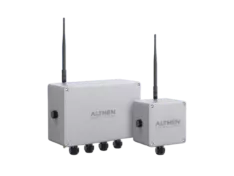
BM-Y1-C1 & BM-Y1-C4 Analogue nodes
- 24-bit low-noise ADCs
- Mesh network up to 50 nodes
- Sensor power: 5V, 12V, 24V
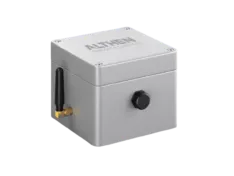
BM-X Wireless tiltmeter node
- ±15° biaxial MEMS inclinometer
- Long-range mesh network up to 5km
- IP67-rated die-cast housing
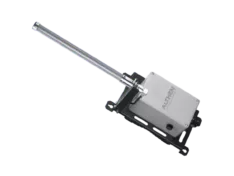
BM-Z Industrial IoT Gateway
- Long-range mesh up to 5km
- Secure 3G/4G and Wi-Fi data
- IP67 & -40°C to +80°C range
Installation without disruption
The compact, battery-powered nodes were installed across slopes, bridge arches, and the rail track itself without interrupting train operations. Each sensor node was configured for a custom sampling rate (ranging from every 5 minutes to hourly), depending on the risk level at that location. Rugged IP67 enclosures and optional solar panels ensured reliable, 24/7 operation in harsh weather.
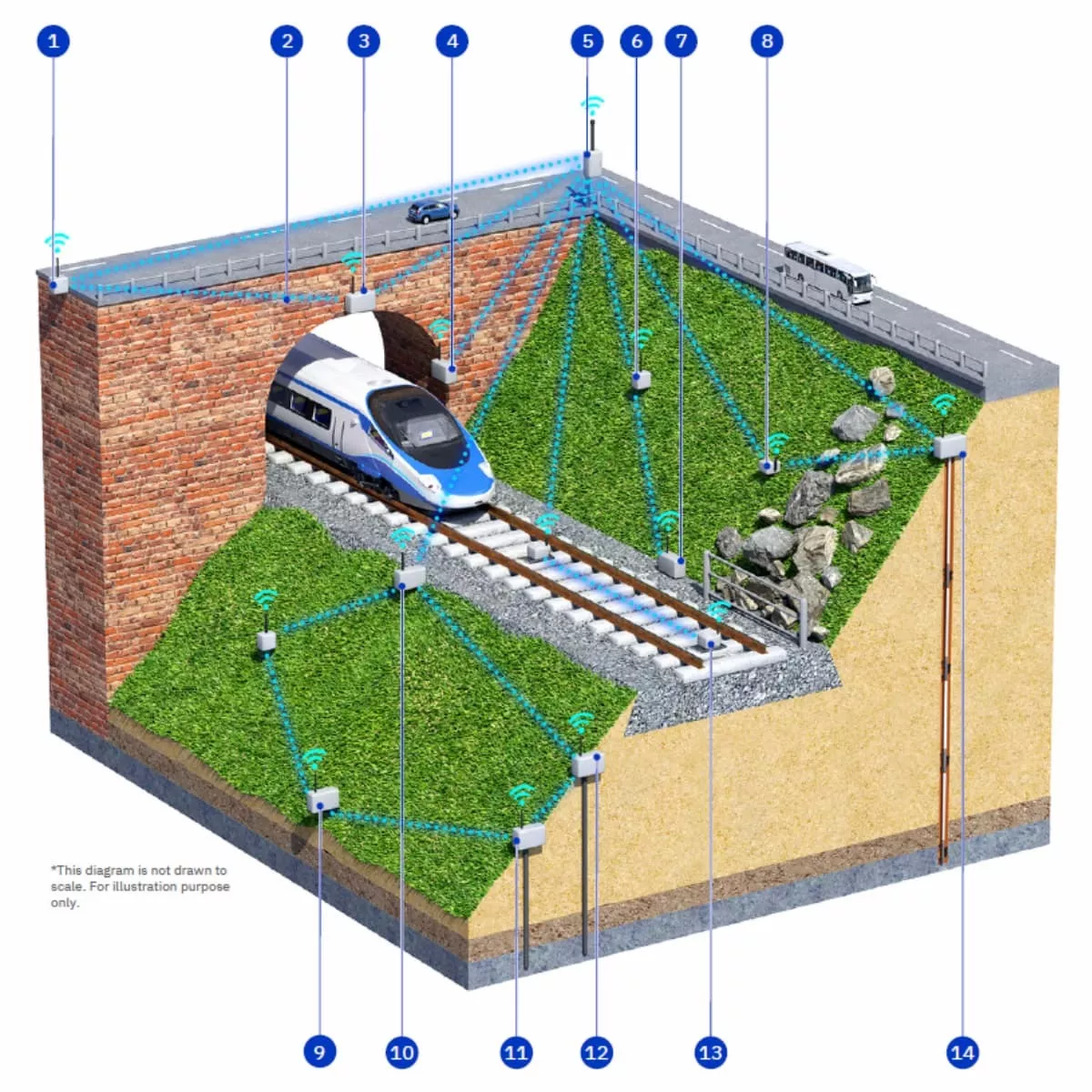
Remote monitoring solution
This system fully automates the process and provides real-time data on key parameters such as load, stress, tilt and displacement. Here’s how that works.
01. Monitoring total pressure: BM-Y1-C1 (1 channel) Nodes automate the monitoring of a pressure cellwhich measures total earth pressure under the road.
02. Mesh: System’s patented long-range wireless MESH network connects theNodes to the Gateway. The mesh network is self-healing, enhancing thetransmission reliability. The ability to ‘hop’ significantly increases thereliability in complex environments and offers the ability to increaseaggregate range if required. The system is highly flexible and scaleable.
03. Bridge arch displacement monitoring: BM-Y1-C4 (4 channels) Nodes automate the monitoring of a multi-pointin-line extensometer that measures vertical and horizontal deformation atthe bridge arch.
04. Monitoring stress change: BM-Y3-C8 (8 channels) Nodes automate the monitoring of a vibrating wirestressmeter in the bridge arch.
05. Gateway: The BM-Z receives sensor data from the Nodes within thenetwork. The software that runs on the Gateway is used toconfigure and manage the project. It also provides the optionto push the data via FTP/API to a selected server and/orsoftware of your choice.
06. Nodes: Each battery-operated Node acquires data from multiple sensorsand transmits the sensor data wirelessly through the Mesh network to the Gateway.
07. Detecting rock falloff: BM-Y3-C8 (8 channels) Nodes monitors rock falloff from the slope throughconnected to a rock fall detection system activited by vibration signal.
08. Slope stability monitoring: BM-X Nodes can be used to monitor the slope stability on and around therailway.
09. Slope health monitoring system - displacement: BM-Y1-C1 (1 channel) and BM-Y1-C4 (4 channels) Nodes ensure real-timemonitoring of displacement sensors to ensure the safety of the slope.
10. Subsoil settlement displacement monitoring: In-depth lateral displacements of the subsoil due to instability and/or presenseof discontinuities can be monitored using a string of in-place inclinometersconnected to BM-Y4 Nodes.
11. Ground settlement monitoring: BM-Y1-C4 (4 channels) Nodes automate the monitoring of a multi-pointborehole extensometer (MPBX) that measures vertical deformation at various depths.
12. Monitoring pore water pressure: Piezometers measuring the underground pore water pressure are monitored inreal-time using BM-Y2-C1 (1 channel) and BM-Y3-C8 (8 channels) Nodes.
13. Track monitoring: Wireless tiltmeter BM-X Nodes measure track conditions including rail cant,twist and height variation.
14. Settlement displacement monitoring: Settlement/lateral displacement of the slope is monitored by leading brandsof digital in-place-inclinometers (IPI's)/MPBX/extensometers/SAAs in real-time using BM-Y4 Nodes.
What the data revealed and prevented
Thanks to real-time alerts and trend analytics, the railway team was able to take preventative action—avoiding a costly disruption caused by slope instability near a commuter hub. Within weeks, the system began providing clear insights into:
-
Slope stability trendsindicating potential landslide zones
-
Bridge arch displacementduring freeze-thaw period
-
Changes in rail cant and twistthat could lead to speed restrictions
Why Althen Sensors & Controls? A trusted partner for long-term reliability
What set us apart wasn’t just the technology. It was the complete support package:
- End-to-end project delivery
- Local training and remote support
- Integration with legacy instruments
- Scalable design for future expansion
With a single point of contact and extensive experience in geotechnical and structural monitoring, we proved to be a reliable, long-term partner.

Let’s future-proof your railway too
Want to monitor your rail infrastructure in real time, reduce inspection costs, and increase safety?