
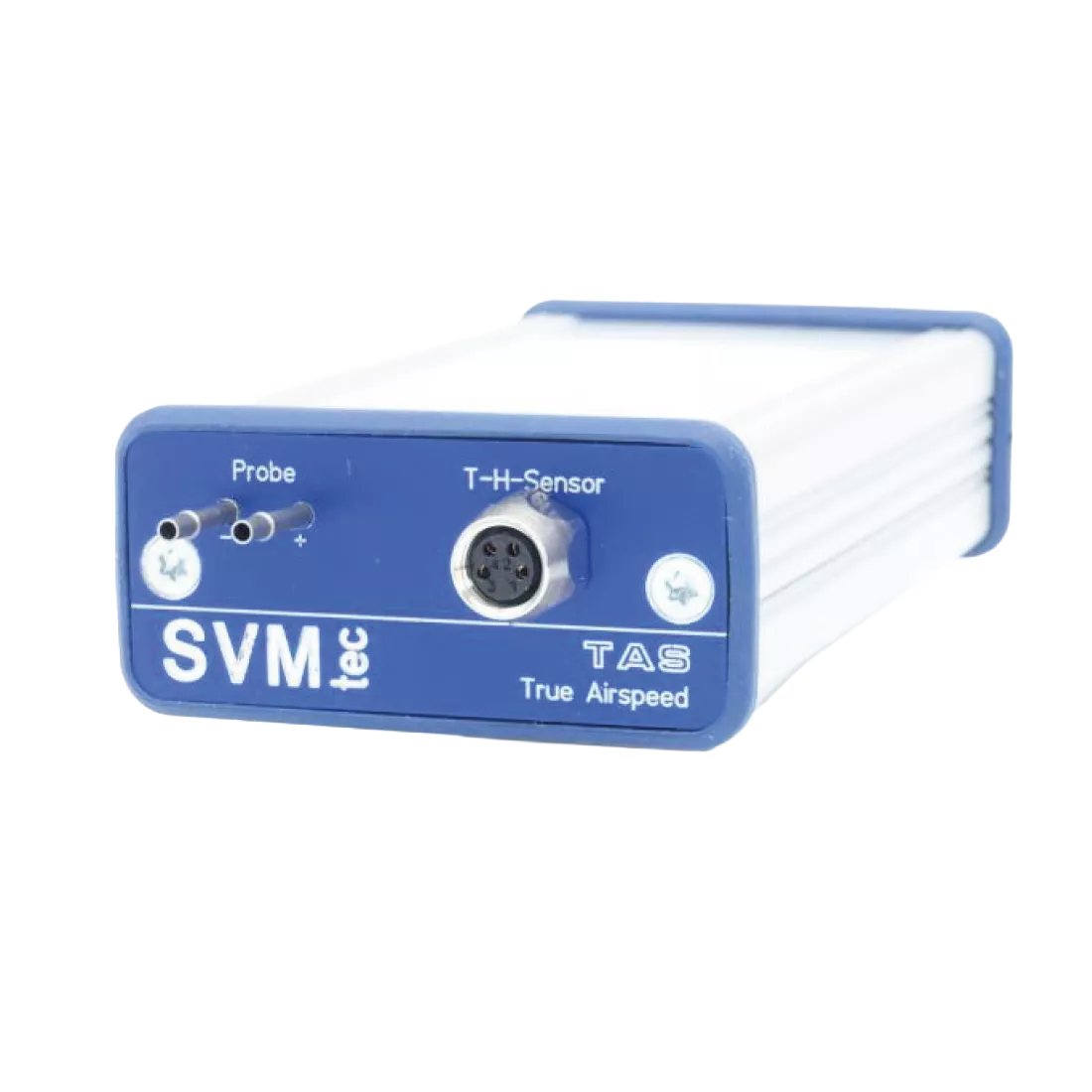
True Air Speed
Airspeed measurement for aerodynamic probes
Key features
- Wide measuring range (1-250m/s)
- Pressure measurement ranges selectable from 250Pa to 15kPa
- Barometric pressure sensor
- PT100 temperature sensor
- Humidity sensor
- USB or CAN (optional)
- Sampling rate per channel up to max. 100Hz
- Software and libraries for LabVIEW and DBC files are included
About the True Air Speed
The measuring instrument is suitable for determining the flow velocities of air flows in conjunction with a pressure probe (e.g. Prandtl probes) or a restriction flow meter. The following quantities can be measured:
- Differential pressure = Pitot or differential pressure of the probe
- Differential pressure of the static pressure of the probe versus ambient pressure
- Ambient pressure (barometric air pressure)
- Temperature
- Relative humidity
These variables and the flow velocity calculated from them are output via the interface.
Two pressure sensors with different measuring ranges are installed to measure the differential pressure. Depending on the measured pressure, the sensor with the highest accuracy is automatically used to calculate the flow velocity.
For the determination of the dynamic pressure, which is necessary for the determination of the flow velocity, a suitable pressure probe is additionally required, e.g. Prandtl probe, Pitot probe or nozzle pressure. In order to be able to cover a large velocity range, two pressure sensors with different ranges are installed, which are internally connected in parallel.
The second variable necessary for determining the flow velocity is the density. This is determined via the measured variables air pressure, temperature and humidity. In order to also be able to measure in flows with negative or positive pressure to the environment, another differential pressure sensor is installed, which determines the difference between the environment and the static pressure connection of the probe.
The data transmission uses ASCII text in the respective SI units. Via a simple protocol, the transmission rate can be set in the range between 1 and 100 Hz. For the differential pressure sensors an offset deduction (TARA) can be done via the software.
Power is supplied via the USB interface. An additional power supply is not necessary in this case. Optionally, the CAN bus can be used. In this case, an external supply in the range of 7 to 24VDC is necessary, which is supplied via the interface connector with M8 plug.
The configuration is done via the USB connection. When connected via USB, the scanner logs on to the system as a virtual COM port. This allows any software that supports a serial protocol to be used. A sample program for use with LabVIEW is included.
For the devices with CAN bus, a DBC file is also supplied.
Do you need this sensor for your next project?
Request a no-obligation quote or send us your contact details for a free, no-obligation consultation. Our sales engineers will then contact you within a maximum of 1 to 2 working days.
Product downloads
Talk to our experts
Not exactly what you are looking for? We offer standard sensors, but can also help you with sensors adapted for you or a fully customised measurement solution. Contact us for advice or pricing.
Talk to an expertTechnical Specifications
| Specification | Value |
|---|---|
| Differential pressure / Measurement range, | 2,5 - 150 mbar |
| Airpressure / Measuring range | 700 to 1200 hPa (mbar), connected to the reference pressure port (-) |
| Temperature / Measuring range | -50 to 220°C / Uncertainty Class A |
| Humidity / Measuring range | 3 to 97% / Uncertainty ±2 % |
| Power supply | USB Power over USB / CAN 7-24 V, 100 mA |
| Temperature | 5° C…50° C |