

Reliable fuel monitoring for storage and distribution
Our customer operates a distributed network of fuel storage tanks supplying diesel and gasoline to industrial processes. Maintaining accurate fuel levels is critical for:
- Preventing downtime due to empty tanks
- Avoiding overfilling and environmental risks
- Optimizing logistics and refueling schedules
- Ensuring compliance in hazardous environments
Legacy systems lacked reliability and remote accessibility, making it difficult to scale operations efficiently. In addition, the absence of a centralized fuel level monitoring system limited real-time visibility across multiple sites. Existing measurement methods showed inconsistencies due to temperature variations, fuel density changes, and sensor drift, reducing overall accuracy.
To overcome these challenges, our longterm customer required a robust solution based on hydrostatic level measurement using pressure sensors, capable of delivering continuous, high-accuracy data. The system needed to support industrial communication outputs (4–20 mA) and integrate with enabled data acquisition platforms for remote monitoring, diagnostics, and predictive maintenance.
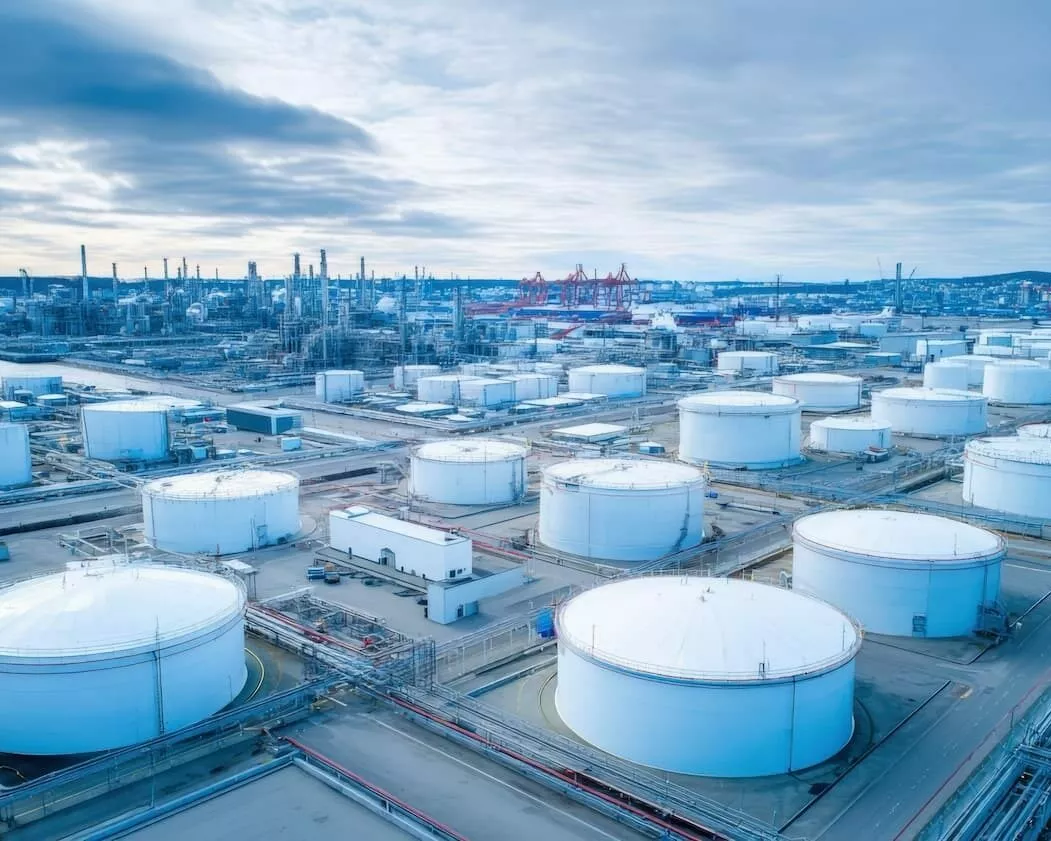
Challenges in fuel tank level measurement
The customer required a solution that could:
- Deliver continuous and accurate level measurement
- Operate reliably in harsh outdoor and industrial environments
- Be suitable for flammable fuels (ATEX zones)
- Support remote monitoring with a data acquisition solution and dashboard
- Be scalable across multiple tank types and installations
Technical requirements
- Measurement principle: hydrostatic pressure
- Output: 4–20 mA (with optional digital integration)
- Accuracy: ≤ ±0.25% FS
- High chemical resistance and long-term stability
These requirements ensured reliable level measurement under varying operating conditions, including temperature fluctuations and changing fuel properties. The solution needed to provide stable, drift-free signals for accurate monitoring over time. In addition, compatibility with industrial data acquisition and wireless dashboard systems was essential to enable real-time monitoring and seamless integration into existing infrastructure.
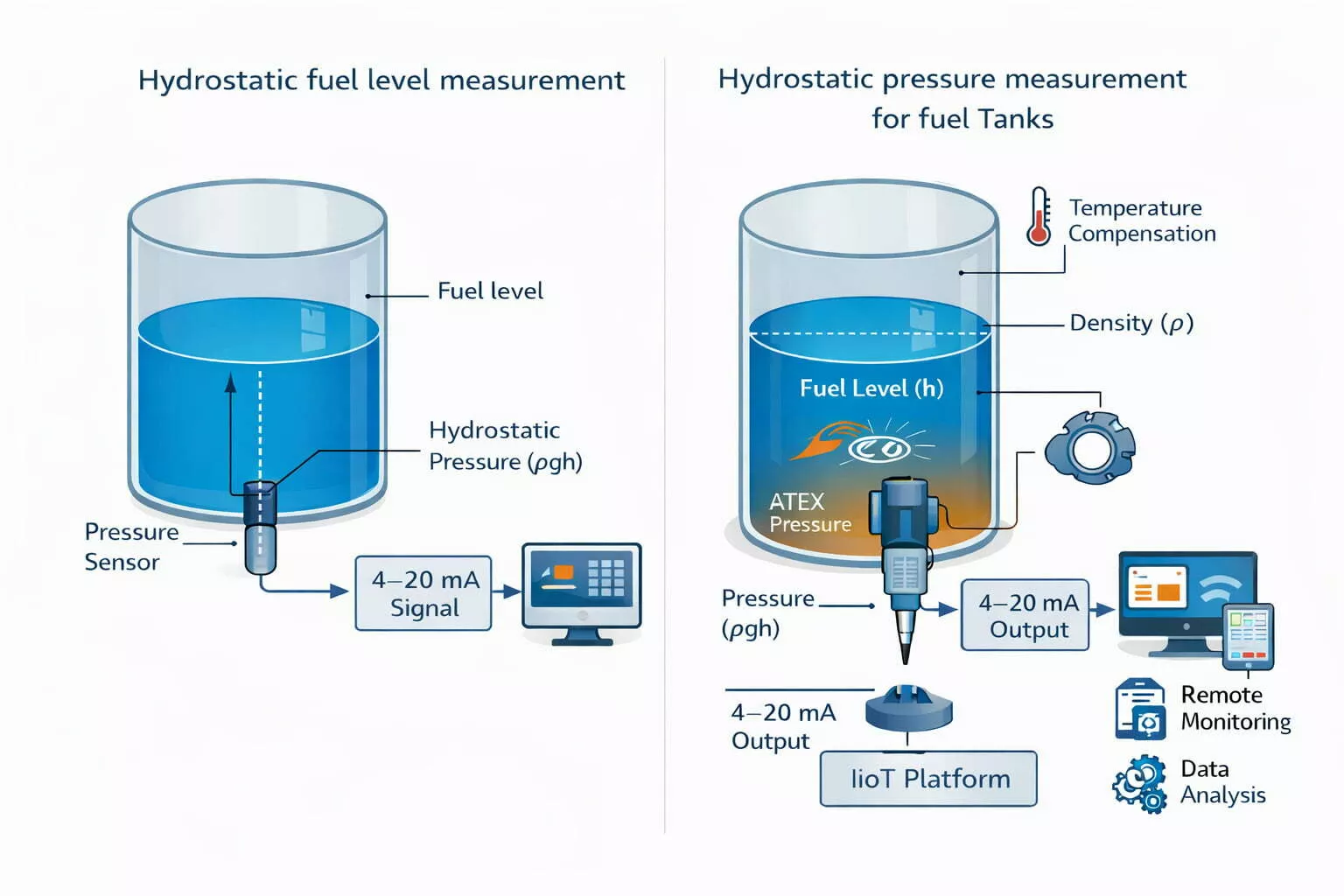
Hydrostatic pressure measurement for fuel tanks
Hydrostatic pressure measurement is a reliable method for fuel tank level monitoring. It works by measuring the pressure created by the fuel column, which directly correlates to the fill level.
Flexible measurement setup using different models
Using pressure sensors installed at the bottom of the tank or as submersible probes, this method provides accurate and continuous level data. It is well-suited for diesel and gasoline applications, offering stable performance under varying temperatures and operating conditions.
With standard outputs like 4–20 mA and compatibility with monitoring systems, hydrostatic measurement enables real-time, low-maintenance fuel level monitoring.
- MPM416W submersible transmitters were installed inside storage tanks for direct level measurement, and the highest accuracy in standard tanks.
- MPM489W transmitters were mounted externally on tank bottoms or pipelines where immersion was not preferred
- MPM486 explosion-proof transmitters were deployed in hazardous (ATEX) zones to ensure compliance
Selected pressure sensors
Fuel monitoring
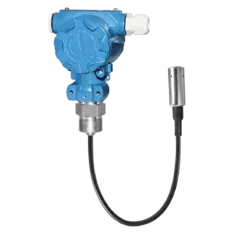
MPM416W Submersible Level Transmitter
- High accuracy measurement
- Fully sealed stainless steel
- Explosion-proof optional
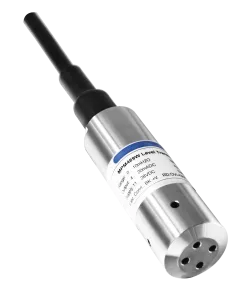
MPM489W Submersible level transmitter
- Fully sealed submersible
- Wide measuring range
- Multiple output signals
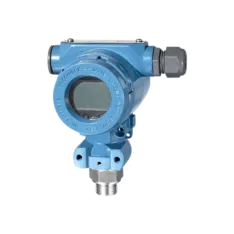
MPM486 LCD HART pressure transmitter
- 4~20mA current output together with HART® (2-wire);
- Digital compensation and linearity correction;
- -10°C ~80°C digital wider temperature compensation;
- Local and long-distance zero, range adjustment;
Integration
- Sensors were connected via 4–20 mA outputs to Althen-compatible data acquisition and monitoring systems
- Data was collected using our solutions and signal conditioning modules
- Measurements were visualized through custom dashboards and cloud-based monitoring platforms
- Real-time alerts were configured for critical fuel levels and system anomalies
Testing
- Sensors were tested for accuracy, repeatability, and stability
- Performance was validated under temperature variations and dynamic operating conditions
The accuracy and stability of the measurements have significantly improved compared to the previous setup. Integration into the monitoring system was straightforward and gives much better control over the inventory.

Improved safety, efficiency and control
Althen delivered a tailored fuel monitoring solution by combining application expertise with reliable pressure sensor technology. The system was designed for seamless integration, long-term stability, and real-time monitoring via dashboard platforms.
-
High-accuracy, reliable fuel level monitoringacross all storage tanks
-
Improved operational efficiencythrough real-time data and remote insights
-
Enhanced safety and compliancein hazardous fuel environments
Combining application knowledge and sensor technology
For this project, we worked closely our with customer to define a suitable fuel monitoring approach, selecting and combining the right pressure sensors based on the application requirements rather than applying a standard solution.
By focusing on practical integration, reliable components, and compatibility with existing systems, the solution supports accurate level measurement with minimal maintenance. In addition, the setup allows for straightforward connection to data acquisition and IIoT monitoring platforms, enabling better visibility across multiple tank locations.
If you are facing similar challenges in fuel level monitoring or tank measurement, feel free to get in touch with our team to explore a suitable solution for your application.

Looking for a similar fuel monitoring solution?
feel free to get in touch with me to explore a suitable solution for your application.