

Project overview
A rail infrastructure operator required a permanent monitoring system to detect track displacement caused by soil movement, thermal expansion and heavy axle loads. Manual inspections and measurement trains provided only periodic data and could not detect sudden changes.
The customer required:
- High-resolution linear displacement measurement
- Long-term stability with minimal drift
- Operation in harsh outdoor environments
- Resistance to vibration, moisture, and temperature variation
- Compact design for installation near track structures
- Analog output compatible with remote data logging systems
- Minimal maintenance over extended periods
Measurement requirements included:
- Range: up to several hundred millimeters (depending on location)
- High repeatability under cyclic loading
- Reliable performance in extreme weather conditions
The objective was clear: early detection of track movement to enable predictive maintenance and prevent service disruption.

Project implementation
The selected P111 sensors were installed between fixed structural reference points and moving rail or support elements. Thanks to its inductive, non-contact measurement principle, the sensor offers high durability in vibration-heavy environments.
Implementation steps included:
- Mechanical mounting in protected housing
- Electrical integration into remote data acquisition system
- Baseline calibration under static conditions
- Validation during live train operation
- Configuration of threshold-based alarm notifications
The system was fully integrated into the operator’s infrastructure monitoring dashboard.
Sensor installation
The P111 Rugged linear position sensor was installed between fixed structural reference points and moving rail or support components. The inductive measurement principle ensured:
- Non-contact, wear-free operation
- High shock and vibration resistance
- Long operational lifespan
Sensors were mounted in protective housings and connected to a centralized data acquisition system.
Selected product
High-frequency response (>10 kHz) and linear output.
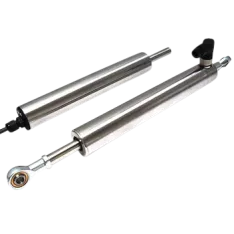
P111 Rugged linear position sensor
- Factory-calibrated travel range from 0–800 mm
- Rugged stainless steel housing with IP65/IP67 sealing
- Multiple output options: voltage, current, ratiometric

Data acquisition and testing
During commissioning:
- Baseline displacement values were recorded
- Sensors were validated under dynamic train loads
- Measurement output was integrated into the railway’s remote monitoring platform
Real-time alerts were configured to trigger when displacement thresholds were exceeded.
-
Continuous 24/7 displacement monitoring
-
Early detection of sub-millimeter track movement
-
Faster response to ground instability events
Other results: Impact and performance
After implementation, the operator achieved:
- Continuous 24/7 displacement monitoring
- Early detection of sub-millimeter track movement
- Faster response to ground instability events
Unscheduled track closures were reduced as maintenance teams gained real-time insight into structural behaviour under live train loads and changing environmental conditions. Instead of relying solely on periodic inspections, gradual displacement trends could now be identified early, enabling a shift from reactive repairs to predictive maintenance planning.
Following commissioning and baseline calibration, the system demonstrated stable long-term performance in harsh outdoor railway conditions, with no significant signal drift observed.


Contact us
and move from periodic inspections to continuous, intelligent railway monitoring.