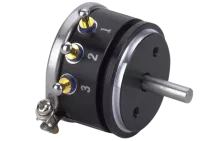
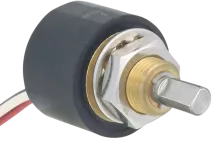
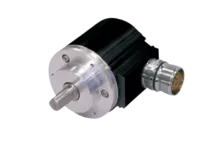
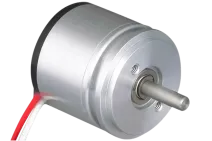
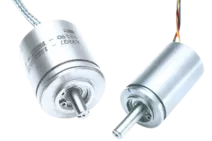
Incremental rotary encoders for the textile industry
Angular position sensors for precise rotation and direction measurement
Althen’s angular position sensors enable precise angle measurement by converting mechanical rotational positions into electrical signals. To determine angular displacement and direction of rotation, a range of technologies is available, including incremental encoders, rotary pulse encoders, and absolute angle sensors. Inductive sensors offer a compact, configurable, and highly durable solution, making them ideal for demanding industrial environments. The portfolio also includes sensors based on differential transformer principles (LVDT/RVDT), as well as inductive and potentiometric variants, covering measurement ranges from 10° up to 360°.
Our product range
We offer standard rotary position sensors but can also help you with a customized desin or a complete measurement solution.
Althen Sensors & Controls has established itself as a reliable provider of rotary position sensors, offering a range of high-precision solutions with unique features tailored to meet the needs of diverse industries. With a commitment to quality, durability, and innovation, Althen continues to play a pivotal role in advancing technology across various sectors through its cutting-edge sensor solutions.
Althen offers you a wide range of angle sensors based on different technologies. Classic rotary angle sensors (also known as angle sensors, inductive sensors or protractors) work according to the principle of the differential transformer (LVDT). The rotary angle sensors from Althen are a special form of LVDTs, so-called RVDTs (Rotary Variable Differential Transformer). They can be individually configured and have a very long service life. Our customers often use them for hydraulic servos in ailerons in aerospace technology and in engine and fuel system controls. Potentiometric rotary position sensors are divided into two groups according to their design: single-turn and multi-turn rotary position sensors. Both are frequently used in OEM applications.
Althen offers a broad selection of rotary position sensors based on different technologies.
Conventional rotary position sensors (also: angle sensors, inductive sensors, goniometers) are based on the principle of differential transformers (LVDT). Althen rotary position sensors are a special type of LVDTs called RVDTs (rotary variable differential transformers). They can be configured to suit specific needs and are very durable. Our customers typically use them in hydraulic servos for control surfaces in aerospace engineering, or for controlling engines and fuel systems.
Rotary potentiometers can be divided into two categories: single-turn and multi-turn rotary position sensors. Both are commonly used in OEM applications. They are available in small or medium quantities at relatively low cost.
Every rotary position sensor has a primary coil and two secondary coils. The transmitter core works contactless and is mounted on high-quality bearings, so that the rotary position sensor offers effectively wear-free operation. These inductive sensors require alternating current supply voltage.
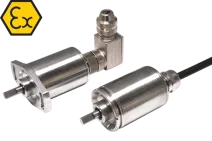
Other sensors in our portfolio use advanced inductive technology. These rotary position sensors (also: angle sensors, inductive sensors, rotation sensors) have only one secondary coil. The stable, non-linear output signal is linearized using application-specific integrated circuitry (ASIC). Integrated amplifiers output the signal as an analogue voltage or current signal. For optimum measuring results, choose from a broad range of different operating voltages and output signals. A special version featuring a Zener barrier is certified for use in explosive hazard environments. We supply these intrinsically safe ATEX rotary position sensors for Ex II 1G, Ex II 1GD, and Ex i/II M1/1GD hazard zones.
For OEM applications, we supply small and medium quantities of rotary potentiometers. Based on their mechanical properties, they can be divided into two categories:
Our single-turn rotary position sensors have a measurement range of 360 degrees. They are available with or without a mechanical stop at the end of the rotation. A change in resistance depicts the measurement range of 360 degrees as 0 to 5 kOhm.
Multi-turn rotary position sensors can measure beyond the 360 degree limit of a single turn. Multi-turn rotary position sensors have a range of 1800 degrees (5 full revolutions) and map this entire range onto a change in resistance of e.g. 5000 Ohm.

We have the right rotary position sensor for every application. We are happy to support you in your selection. At Althen, we draw on more than 40 years of experience to offer you the optimum solution: fully customised to your requirements. This also includes customised angle sensors as a complete package. The advantage for you is that we are not tied to one manufacturer and can advise you independently. On request, we can customise the measuring system exactly to your needs. Do you have any questions? We are glad to help you!
Answers to the most important technical Questions
Depending on the measurement principle and product series, rotary position sensors can measure different angular ranges. Typical measuring ranges extend from small partial angles for positioning movements up to 360° for full rotational movement. Some sensor types are designed for limited angular ranges, while others support continuous or absolute angle measurement. Potentiometric, inductive, Hall-effect and RVDT rotary position sensors are commonly used for defined angular ranges, for example for position feedback on flaps, valves, levers, shafts or actuators. Incremental and absolute rotary encoders are particularly suitable for rotating axes, speed measurement, position monitoring and multi-turn applications. The appropriate measuring range depends on the application, required angle of rotation, resolution, accuracy, interface, installation conditions and environmental conditions. Althen can help select a suitable rotary position sensor for the required angular range.
The resolution and accuracy of rotary position sensors depend on the measurement principle, product series, angular range, output signal and mechanical integration. Althen offers rotary position sensors for applications ranging from simple angle monitoring to highly precise position feedback in demanding industrial environments. Depending on the sensor type, different performance levels are available. RVDT sensors offer very high repeatability and long-term stability, inductive rotary position sensors operate contactlessly with very high resolution and long service life, magnetic Hall-effect rotary position sensors achieve model-dependent linearity values such as ±0.5% of full scale, and rotary encoders are available, depending on the version, with resolutions from 5 bit up to 36,000 pulses per revolution. The achievable measurement performance also depends on shaft coupling, mounting, temperature, vibration, signal quality, evaluation electronics and environmental conditions. Althen can help select a suitable rotary position sensor for the application.
Yes. Rotary position sensors can provide both absolute and incremental measurement. Absolute rotary position sensors provide a unique position value for every angular position. This means the current position is available immediately after power-up or after a power failure, without requiring a homing procedure. Incremental rotary position sensors, including incremental rotary encoders, detect changes in position using pulses. The control system counts these pulses and uses them to determine direction of rotation, rotational speed or relative position. After power-up, a reference procedure is usually required if the exact absolute position must be known. Which version is more suitable depends on the application. Absolute rotary encoders are particularly useful when the position must be uniquely available at all times, for example on safety-related axes or difficult-to-access systems. Incremental measurement is often sufficient for speed measurement, motion monitoring or applications with a defined reference point.
Depending on the measurement principle and product series, rotary position sensors are designed for different temperature ranges. Many industrial Althen versions are developed for demanding environments and can operate reliably under temperature fluctuations, vibration, humidity and harsh operating conditions. The exact temperature range should always be checked in the datasheet of the specific sensor. Magnetic Hall-effect rotary position sensors such as the HSM22 are designed for -40 °C to +105 °C, while the HSM30 is designed for -40 °C to +120 °C. Depending on the design, RVDT and inductive rotary position sensors are also suitable for robust applications requiring high temperature stability. In addition to ambient temperature, important selection criteria include installation conditions, protection rating, temperature fluctuations, vibration, humidity, output signal and required measurement accuracy. Althen can help select a suitable rotary position sensor for the required temperature range and operating conditions.
Depending on the measurement principle and product series, rotary position sensors are available with different electrical interfaces and output signals. Common analogue outputs include resistance, voltage and current signals, for example 0–5 V, 0–10 V, 0.5–4.5 V or 4–20 mA. These signals are well suited for direct integration into control systems, displays, measuring amplifiers or data acquisition systems. For digital applications, depending on the sensor type, interfaces and output types such as incremental pulses, SSI, CANopen, PWM, I²C and SPI are available, along with other industrial communication signals. Incremental rotary encoders provide pulses for rotational speed, direction of rotation and relative position, while absolute rotary encoders or absolute angle sensors can provide a unique position value. The most suitable interface depends on the control system, resolution, response time, cable length, interference environment, supply voltage and integration requirements.
The service life of rotary position sensors depends mainly on the measurement principle, mechanical loading and environmental conditions. Contactless technologies such as RVDT, inductive and magnetic Hall-effect rotary position sensors are particularly durable because there is no mechanical sliding contact subject to wear. Key advantages include long service life, wear-free operation and high measurement accuracy. RVDT sensors operate contactlessly and offer very good long-term stability, high reliability and low maintenance requirements. Inductive rotary position sensors also provide virtually infinite resolution and long service life. Potentiometric rotary position sensors are robust and cost-effective, but they use a resistive track with mechanical sliding contact. Their service life therefore depends more strongly on movement frequency, angle of rotation, rotational speed, bearing load, vibration, humidity and contamination. For applications with very high cycle rates or continuous operation, contactless rotary position sensors are usually the more durable solution.