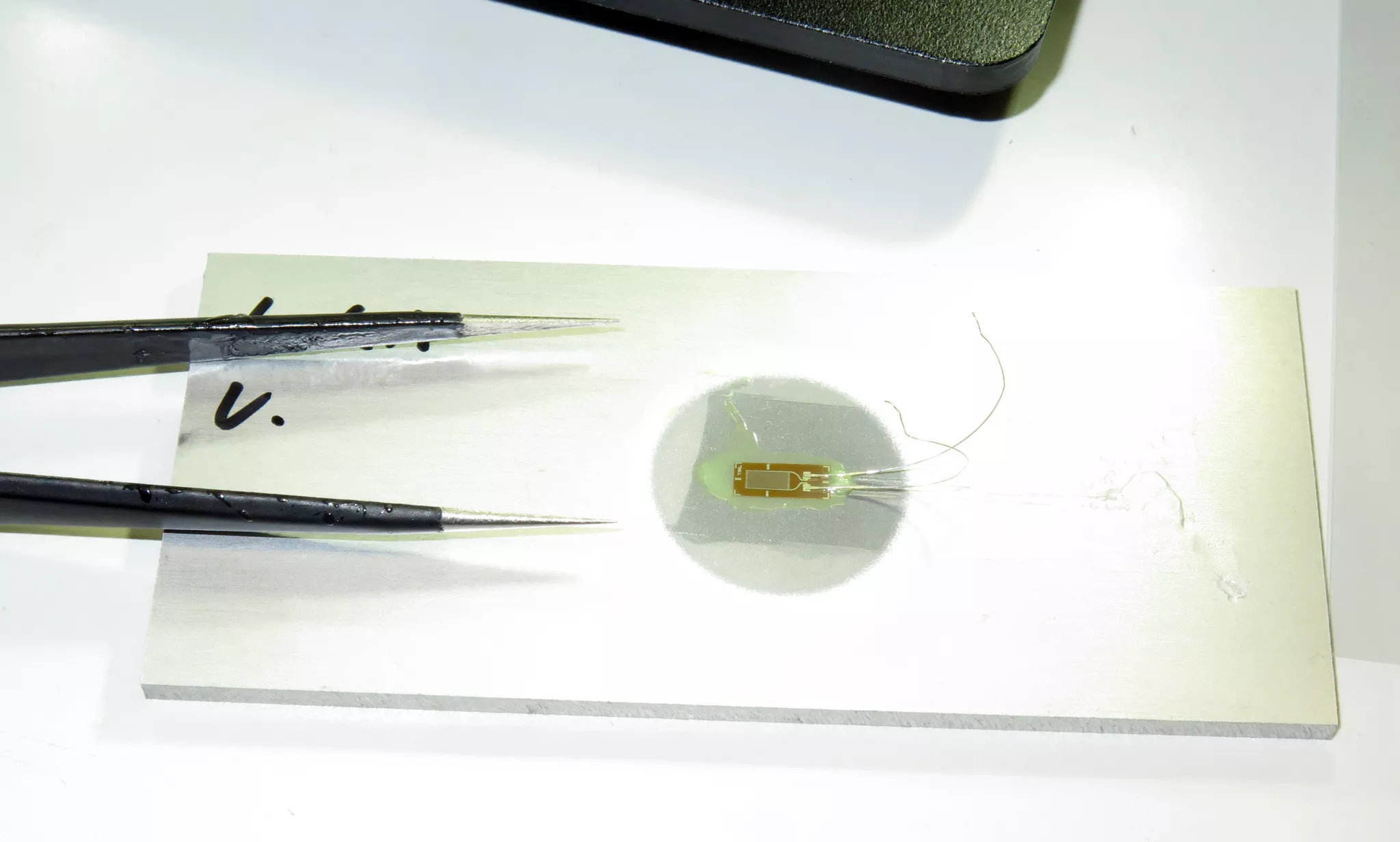
Cyanoacrylate adhesives such as TML’s CN product series enable fast and comparatively simple application of strain gauges. For measurements within the usual elastic strain range, they are well suited for many short-term applications.
However, for very large or plastic strains, the time between application and measurement plays an important role. The maximum strain that can be reliably transferred by a CN adhesive bond may decrease as the bond ages. This effect is particularly relevant for so-called post-yield strain gauges, which are used for strains above the elastic limit of the material.
What is CN adhesive?
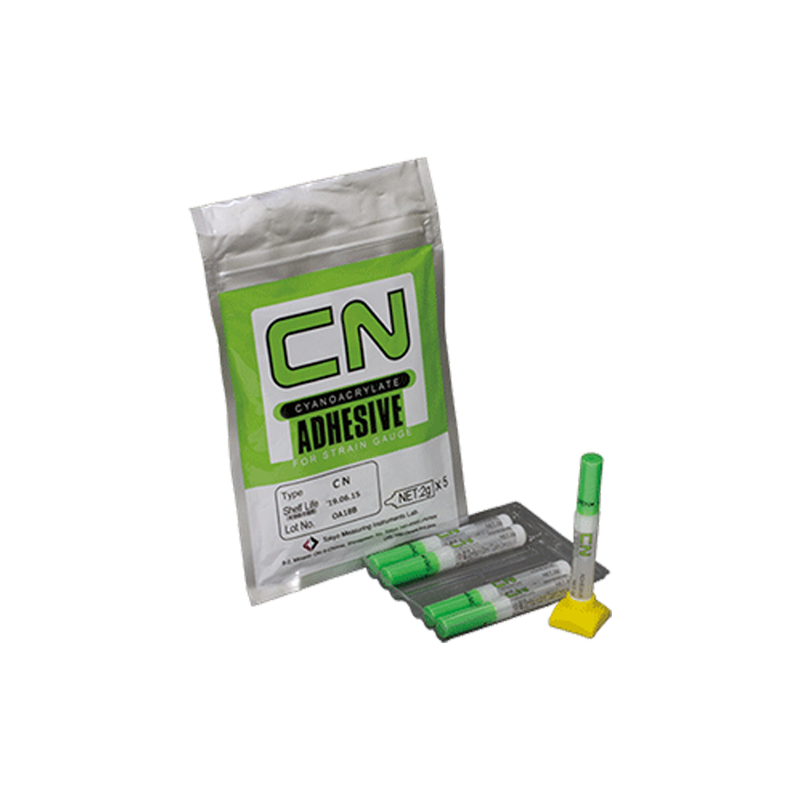
CN is a fast-curing cyanoacrylate adhesive for the application of suitable strain gauges. It is primarily used for short-term measurements at room temperature and under controlled environmental conditions. Practical advantages include the short pressing time, rapid curing and low installation effort. This allows a measuring point to be prepared and put into operation within a short period of time.
However, the suitability of the adhesive does not depend solely on its bonding strength. What matters is that the strain of the component is transferred reliably and reproducibly through the adhesive layer to the backing and measuring grid.
Distinguishing between normal strain and large strain
In conventional strain gauge measurements, elastic strains are usually measured. After unloading, the component largely returns to its original shape. The strain is typically well below one percent. Post-yield strain gauges, by contrast, are used for significantly larger strains where the material is already undergoing plastic deformation. Depending on the strain gauge series, strains from several percent up to the double-digit percentage range can be measured.
These measurements place significantly higher demands on:
- the measuring grid,
- the backing,
- the adhesive,
- surface preparation,
- the uniformity of the adhesive layer.
An adhesive bond that is perfectly adequate for a normal elastic strain measurement is therefore not automatically suitable for a large-strain measurement.
Products
Post-Yield DMS for Large Strains
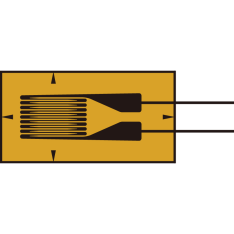
YFLA Series Strain Gauges for Very High Strain
- Strain limit 15~20% (150000~200000×10⁻⁶ strain)
- Operational temperature: -30~+80°C
- Special plastics backing, Cu-Ni element
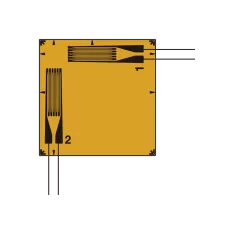
YEFCA Series Strain Gauges for High Strain Usage
- Strain limit 10~15% (100000~150000×10⁻⁶ strain)
- Operational temperature: -20~+80°C
- Dual element 0°/90° plane type
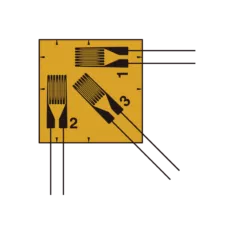
YEFRA Series Strain Gauges for High Strain
- Strain limit 10~15% (100000~150000×10⁻⁶ strain)
- Operational temperature: -20~+80°C
- 3-element 0°/45°/90° plane type
Why does the transferable strain limit decrease over time?
After curing, a cyanoacrylate adhesive bond continues to change. Moisture, temperature, aging and environmental conditions can influence its mechanical properties. Over time, the bond may become more brittle or lose its ability to transfer very large deformations uniformly. At high strains, this can lead earlier to local debonding, cracking in the adhesive layer or failure of the strain gauge.
This change over time primarily affects the maximum transferable strain. For measurements within the usual elastic range, it is often considerably less critical than for large plastic-strain measurements.
Changes in CN adhesive over time
TML investigated the changes in CN adhesive bonds over time under different temperature and humidity conditions. Post-yield strain gauges were among the gauges used in these tests. The results generally show that the maximum achievable strain can depend on the time elapsed since application and on the environmental conditions. Higher temperature or humidity can additionally influence the aging of the adhesive bond.
Important influencing factors include:
- strain gauge used and measuring-grid length,
- adhesive type,
- specimen material,
- surface preparation,
- temperature and relative humidity,
- storage duration,
- loading rate,
- definition of the strain limit,
- number of specimens tested.
The following figure shows an example of the results of tests carried out by TML using the YFLA-5 strain gauge model. The results show clear differences depending on the exposure conditions of the specimens (temperature and humidity), but they also demonstrate that the strain limits of the strain gauge adhesive bond decrease over time.
While this is not a problem for conventional strain measurements, for large-strain measurements it is recommended that testing be completed within one or two days after installation. If the strain gauge is to remain installed for a longer period before the measurement is carried out, a special adhesive should be used, such as CN-Y.
When is CN-Y useful?
CN-Y is a special cyanoacrylate adhesive from TML for certain post-yield strain gauges. It was developed for applications in which a large-strain measurement is not performed immediately after installation but only after several days.
The adhesive is intended in particular for approved TML strain gauges of the YEF, YF and YHF series. Compared with standard CN, it is designed to reduce the age-related deterioration in maximum strain transfer.
CN-Y is not, however, a universal long-term adhesive. Its strength lies in delayed measurement of large plastic strains using the strain gauges intended for this purpose. For general long-term measurements in the elastic range, high temperatures or continuous exposure to moisture, other adhesive systems may be more suitable.
Start of measurement, curing and aging are not the same
When evaluating an adhesive, several different time specifications must be distinguished.
The pressing time describes how long the strain gauge must be held under pressure during initial fixation. The earliest measurement time indicates when an initial measurement is generally possible. Full curing describes the further development of the adhesive bond.
This must be distinguished from aging after application. Aging describes how the properties of the finished adhesive bond change over days, weeks or months.
An adhesive can therefore be ready for measurement shortly after application without automatically being suitable for long measurement periods, high temperatures or very large strains.
Importance of a thin and uniform adhesive layer
The adhesive layer must transfer the strain of the component to the strain gauge with as little loss as possible. For this reason, it should be applied thinly and uniformly in accordance with the manufacturer’s instructions.
An adhesive layer that is too thick or uneven can:
- impair strain transfer,
- increase creep and hysteresis,
- create local stress concentrations,
- promote air inclusions,
- change the thermal behaviour of the measuring point.
The decisive factor is not whether the strain gauge is positioned a few micrometres closer to or farther from the component surface. What matters is the mechanical quality and uniformity of strain transfer.
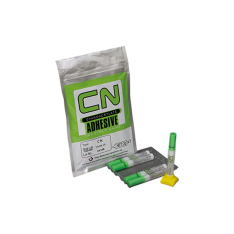
CN-Y adhesives (Post-yield)
- Easy-to-use
- Suitable strain gage series: YF and YEF
- Suitable materials: Metals, CFRP, GFRP and Plastics
Influence of application quality
The achievable strain limit does not depend solely on the type of adhesive. Preparation and execution of the bonded measuring point are also crucial. The surface must be free of grease, oxides, moisture and dust. The strain gauge must be positioned precisely and aligned in the intended direction. The pressing pressure should be uniform and the specified pressing time should be observed.
A suitable transparent installation tape can be used for positioning. It holds the strain gauge in the intended position and can serve as a hinge while the adhesive is applied. Even small defects in the adhesive layer can significantly reduce the maximum transferable strain.
Dust, air bubbles and local defects
There must be no dust particles, fibres or air inclusions underneath the strain gauge. Such defects interrupt uniform strain transfer. This can create local stress peaks in the backing or measuring grid. Possible consequences include:
- measurement deviations,
- local debonding,
- reduced fatigue strength,
- premature breakage of the measuring grid.
Such defects are particularly critical in large-strain measurements. They should not be regarded as negligible even in short-duration tests..
When is a different adhesive required?
CN adhesives are particularly suitable for controlled, relatively short-term applications. At elevated temperatures, high humidity, long measurement periods or where particularly high stability and accuracy are required, a different adhesive system may be necessary.
Depending on the application, epoxy, polyester or phenolic resin adhesives may be suitable, for example. Selection depends on:
- strain gauge series,
- component material,
- temperature range,
- measurement duration,
- maximum strain,
- static or dynamic loading,
- available curing method,
- protection system.
An epoxy adhesive is not automatically suitable for every long-term or high-temperature measurement. Likewise, polyester resin is not generally the best solution for humid conditions. The decisive factor is always whether the strain gauge manufacturer has approved the specific combination.
Heat-curing adhesives
Some adhesives require a defined curing process at elevated temperature. Temperature, duration and pressing pressure must be observed precisely.
During heating, the viscosity of the adhesive may change. However, this behaviour is product-specific. It must not be assumed that every heat-curing adhesive will automatically distribute itself optimally in an oven. Excessive flow can even impair the adhesive layer. Pre-curing, post-curing and controlled cooling may also form part of the prescribed process. All parameters must therefore be taken from the data sheet of the specific adhesive.
Products
Heat-curing adhesives
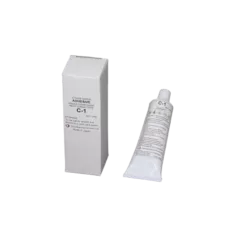
C-1 adhesives (Long-term measurement, Transducer-specific)
- Suitable for metals
- Temperature range for cured adhesive: -269 to +200 ℃
- For long periods in high temperatures
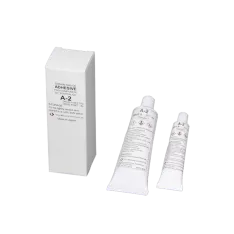
A-2 adhesives (Bolt embedding)
- Suitable for BTM strain gauges
- Temperature range of cured adhesive: -30 to +100 ℃
- Suitable for use on bolts
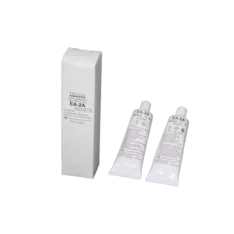
EA-2A adhesives (Cryogenic temperature)
- Suitable for CF strain gauges
- Temperature range of cured adhesive: -269 to +50 ℃
- Suitable for metals, concrete and composite
Protection against moisture
Cyanoacrylate adhesive bonds and electrical connection points must be adequately protected in humid conditions or during extended use. The protective coating should cover not only the strain gauge itself, but also solder terminals, lead wires and cable transitions. Penetrating moisture can reduce the insulation resistance between the measuring circuit and the component.
Possible consequences include:
- leakage currents,
- zero-point drift,
- noise,
- unstable measurement values,
- corrosion at connection points.
The protective coating must be suitable for the temperature range, measurement duration, mechanical loading and environmental conditions.
Produkte
Beschichtungen für DMS
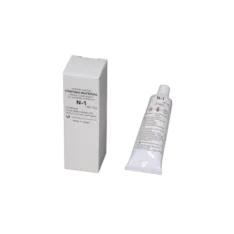
N-1 Chloroprene rubber based solvent thinned
- Moisture- and waterproof coating
- No need for mechanical protection
- Air-drying
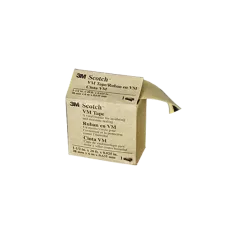
VM Tape butyl rubber
- Excellent moisture and water resistant characteristics
- Easy-to-use
Difference between adhesive shelf life and service life of the bonded measuring point
The shelf life of unopened adhesive must not be confused with the service life of an installed measuring point.
When storing the adhesive, factors to consider include:
- storage temperature,
- protection against moisture,
- protection against light,
- expiry date,
- condition after opening.
The service life of the finished adhesive bond, by contrast, depends on the component, adhesive, strain gauge, loading, temperature, humidity and protection system. A long adhesive shelf life therefore does not automatically mean a long service life of the installed measuring point.
Single and repeated large strain
Post-yield strain gauges are often designed for a single or limited plastic deformation. They are not automatically suitable for repeated load cycles with high strain amplitudes.
A distinction must be made between the following applications:
- single plastic deformation,
- repeated large strain,
- dynamic fatigue measurement,
- static long-term measurement.
A strain gauge capable of measuring 20% strain once does not necessarily have to measure this strain reproducibly over many load cycles. The permissible number of load cycles and the usable strain range must therefore be checked jointly for the strain gauge and adhesive.
Alternative: Weldable strain gauges
Weldable strain gauges provide an alternative to adhesive bonding. In these gauges, the measuring grid is factory-integrated into a weldable assembly with a metallic carrier.
The carrier is attached to a suitable metallic component using a series of small spot welds. This method can enable fast and robust installation, especially where an adhesive is unsuitable because of temperature, humidity or installation conditions.
However, weldable strain gauges are not inherently more accurate or more durable than properly qualified bonded strain gauges. They require a suitable weldable substrate, special tooling and a strain gauge version approved for the application.
For very large plastic strains, it must also be checked whether the weldable assembly and spot welds are able to follow the deformation.
Produkte
Beispiele für anschweißbare Dehnungsmessstreifen
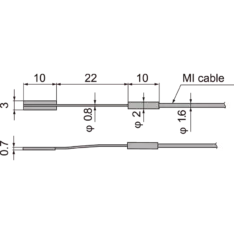
AWMD-5 Full Bridge Strain Gauges for Dynamic Measurement
- Voltage limit 1% (10000×10-⁶ strain)
- Operating temperature: -196~+800°C
- Dedicated to dynamic measurements
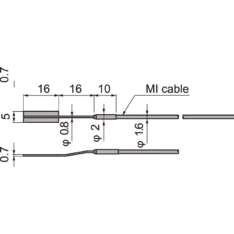
AWMD-8 Full Bridge Strain Gauges for Dynamic Measurement
- Strain limit 1% (10000×10⁻⁶ strain)
- Operational temperature: -196~+800°C
- Inconel backing, Special alloy element
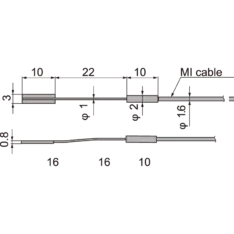
AWHU-5 Full Bridge Strain Gauges for Static or Dynamic Measurement
- 1% (10000×10⁻⁶ strain) Strain limit
- Operating temperature: -196~+800°C
- Static and dynamic measurement
What information is required for selecting the adhesive?
Before selecting an adhesive, at least the following questions should be answered:
- Which strain gauge will be used?
- What is the maximum strain?
- Is the strain elastic or plastic?
- Will the strain be applied once or repeatedly?
- How much time will elapse between application and measurement?
- How long will the measurement take?
- What temperature and humidity conditions will occur?
- What is the component material?
- Is oven curing possible?
- Which protective coating is planned?
Only on the basis of this information can a reliable adhesive recommendation be made.
Common mistakes
A typical mistake is to regard CN-Y generally as a long-term adhesive. In fact, it was developed for delayed large-strain measurements using specific post-yield strain gauges.
It is equally problematic to assume that an adhesive which becomes measurement-ready quickly is automatically fully cured and stable over the long term. An adhesive layer that is too thick, inadequate surface preparation or insufficient moisture protection can also significantly influence the result.
Another mistake is to apply temperature or time limits without considering the specific strain gauge series. Permissible values always apply to a defined system and not to cyanoacrylate adhesives in general.
Conclusion
CN adhesive is suitable for many short-term strain gauge applications and can also be used with approved post-yield strain gauges. However, at very large plastic strains, the maximum transferable strain of the adhesive bond may decrease as the time since application increases.
If the large-strain measurement is not to be performed until several days later, CN-Y may be a suitable alternative for the strain gauges intended for this purpose. CN-Y is not, however, a general-purpose long-term adhesive.
For reliable results, the adhesive, strain gauge, component material, strain range, measurement duration, temperature, humidity and protection system must be considered together. A clean surface, a thin and uniform adhesive layer and a controlled curing process are equally important.
The key point is therefore: The quality of the measurement is determined not by the adhesive name alone, but by a fully matched and professionally applied strain gauge system.


Do you have questions about our strain gauges?
We will be happy to help you select the right products for your measurement project!