Contacting or non-contacting linear position sensors?
Choosing between contacting and non-contacting linear position sensors depends on the specific requirements of the application, including factors such as precision, environmental conditions, and the durability needed for long-term use. Contacting sensors are often used in applications where cost is a critical factor, and physical contact is permissible, while non-contacting sensors are preferred for high-precision applications and environments where wear and tear need to be minimized.
Contacting linear position sensors
They usually involve a direct mechanical connection between the sensor and the moving part. Potentiometric sensors are a common type of contacting linear position sensor. They use a resistive element and a wiper that makes physical contact with the surface. As the object moves, the wiper slides along the resistive element, creating a variable voltage output.
Advantages
- Simple design and construction;
- Generally lower cost;
- Suitable for applications where physical contact is permissible.
Disadvantages
Linear variable differential transformers (LVDT sensors)
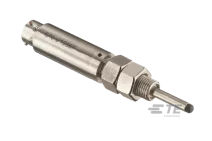
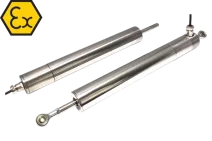
Within their specified measurement range, LVDT sensors provide excellent linearity. They are capable of detecting very small changes in position and have virtually unlimited resolution. As a result, LVDT sensors are also suitable for measuring high accelerations and high measurement cycles.
Linear inductive position sensors
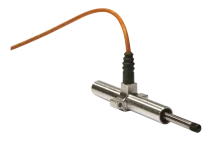
Linear inductive position sensors are durable, long-lived, and especially stable under temperature fluctuations. That means they are ideal for measuring linear travel in almost any industrial setting – especially with hydraulic or pneumatic applications.
Draw-wire sensors
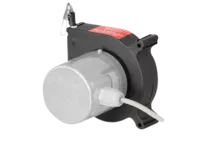
Draw-wire sensors (also called string pot displacement sensors) can measure distances at up to 0.01 mm accuracy. They measure the position and movement of an object by means of a flexible steel cable that is fed from a spring-loaded spool. The linear movement at the end of the cable is thus transformed into a rotational movement.
Linear potentiometers
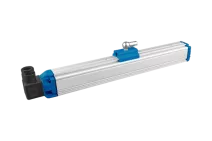
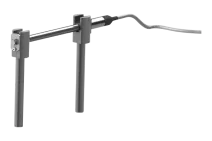
Linear-motion potentiometers (potentiometric sensors and displacement sensors) are based on electrical resistance. Their resistance can be altered mechanically (by rotation or transposition). These sensors are primarily used as continuously adjustable voltage dividers. Althen linear potentiometers are highly compact and lightweight, and they come in various configurations.
Hall effect sensors
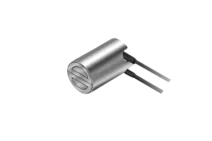
Sensors based on the Hall effect are used to measure the strength of magnetic fields. Their primary applications are in longevity and stress testing as well as for measuring magnetic fields or the thickness of layers. Our Hall sensors are also available in several modified versions for special requirements.
The future of linear position sensors
As technology continues to advance, the demand for accurate and reliable linear position sensors will keep growing. Althen Sensors & Controls supports this development with sensor solutions designed for precision, efficiency, and long-term reliability. From automotive and manufacturing to aerospace applications, linear position sensors play an important role in the ongoing evolution of industrial automation and control systems.